How To Repair Cracks In Cement Driveway
They are not only a tripping hazard, but cracks in your concrete patio, driveway, or walkway can really compromise the curb appeal of your home. You've let these imperfections linger long enough. Here's how to fix them—easily!
- How To Fix Large Crack In Driveway Cement Slab
- How To Repair Cracks In Concrete Driveway
- How To Repair Cracks In Ceiling
- How To Repair Large Cracks In Cement Driveway
Installations of concrete can last hundreds of years, but sooner or later, most end up developing small cracks, gaps, holes, and crevices. If your concrete path, patio, or driveway has begun to show its age, make the necessary repairs sooner rather than later. After all, what’s a small problem today is only going to get bigger and more difficult (or expensive) to fix. While in some cases it takes a pro to work successfully with concrete, almost anyone can fix cracks in concrete.
How To Fix Large Crack In Driveway Cement Slab
Here’s how it’s done.
Repairing cracks in a concrete driveway is a simple project for most DIYers. Whether or not your driveway needs a complete overhaul or just the repair of small weathering cracks, there are products available that make the job easy. Crack Repair and Resurfacing Concrete Driveways. Take extra pains to clean out all the cracks and crevices you may see, no matter how small or thin. You want your concrete patching to have a good surface to adhere to. Once the concrete is completely dry. Prime the concrete with 1 coat of PermaFlex (240 sq ft per gal) using a roller or squeegee. Repair Options for Concrete Driveways. KB Concrete Staining, Norco, CA. Before beginning any driveway repair project. Before you can resurface existing concrete, it’s important to remove any unsound concrete and repair noticeable cracks so the overlay has a solid base to bond to.
MATERIALS AND TOOLS Available on Amazon
– Concrete repair mix
– Hammer
– Chisel
– Wire brush
– Mason’s trowel
– Putty knife
– Protective gear
Photo: shutterstock.com
STEP 1: Choose your concrete repair product.
Concrete surfaces cannot be repaired with concrete. Instead, use a concrete repair mix; these are readily available at home centers and online. Options include epoxy compounds, latex patching material, and mortar mixes. Plumbing design software for mac. This last option works best to fill large cracks (or chipped edges), while the other products are suitable for cracks in concrete that are ⅛-inch wide or narrower.
How To Repair Cracks In Concrete Driveway

STEP 2: Prepare the cracked area for patching.
First, use a small hammer and chisel in combination to knock away any cracked, crumbling, or loose concrete. Chip to a depth of about one inch below the surface plane. Then, rinse the area thoroughly, scrubbing with a wire brush to dislodge any loose, lingering particles.
Bear in mind that this is dusty work. To facilitate cleanup, you may wish to spread a tarp beneath the work area. Most important, be sure to wear the proper protective gear.
Advertisement
STEP 3: Fix the concrete crack with your selected repair product.
- Epoxy or latex. To concrete cracks ⅛-inch wide or narrower, apply an epoxy or latex patching product (view example on Amazon), mixed according to the manufacturer’s specifications. The material goes on either with a mason’s trowel or a putty knife. Force it all the way into the crack, then smooth the product level with the surrounding concrete. Different mixes cure differently; again, consult the directions listed on your chosen product.
- Mortar mix. For larger imperfections in concrete, use a mortar mix. Creating your own mix is as simple as combining one part Portland cement, three parts masonry sand, and just enough water to form a thick paste (though you can also purchase repair mortar mixes, locally or in some cases, online.
Moisten (but do not drench) the problem area, then apply the mortar mix with either a mason’s trowel or a putty knife. As you work, take pains to eliminate air pockets by pressing down firmly on the applied product. Finally, smooth the patch so that it’s level with the surrounding concrete. Let it cure for about two hours, then cover the area with plastic sheeting to keep it moist. Sprinkle water under the plastic every day for a few days or until the surface has hardened up.
Prevent future cracks in concrete by following a few tips from the pros.
One of our first impressions driving up to a home is the driveway. Like anything else, concrete driveways need to be maintained.
Concrete is a very durable building material and an excellent material with which to pour a driveway. Basically, concrete is a mixture of sand, aggregate, water, and cement. The cement is the base in which the sand is embedded and glued together with the help of water.
While we all think of concrete as being very strong, it can be damaged by freezing water, standing water, excessive heat, expansion and contraction of the sand or aggregate from which it is made, shifting of the ground, tree roots, over loading, and even certain kinds of bacteria. Its strength is compression, but it is weaker in tensile strength (pulling) so things like this can easily cause it to crack. Fortunately, repairing most concrete driveway cracks today is a relatively inexpensive, straightforward do-it-yourself project. Download dirt estimation chart pdf.
Resurfacing Concrete
Asphalt driveways have always been popular because they are much less expensive than concrete and easily repaired. One needs only to scratch out the cracks, clean and scour the surface to aid in bonding, and then pour a thin layer of asphalt on the surface. Compress and leave to cure for a few days and the driveway looks good as new.
Years ago, worn concrete driveways were typically replaced and required a very strong back because the old driveway needed to be jack-hammered and the old concrete carted away. Today, there are acrylics and polymer-based cement mixtures that can be used to resurface your old driveway more easily than resurfacing asphalt. One manufacturer makes a driveway repair product made with Portland cement and polymers, which is mixed with water, and can be simply applied with a squeegee or broom. W word of caution: it cures very quickly. Once you add water, you have but 30 minutes to apply a thin even coating before it sets up. That said, it does a great job and truly rejuvenates the driveway.
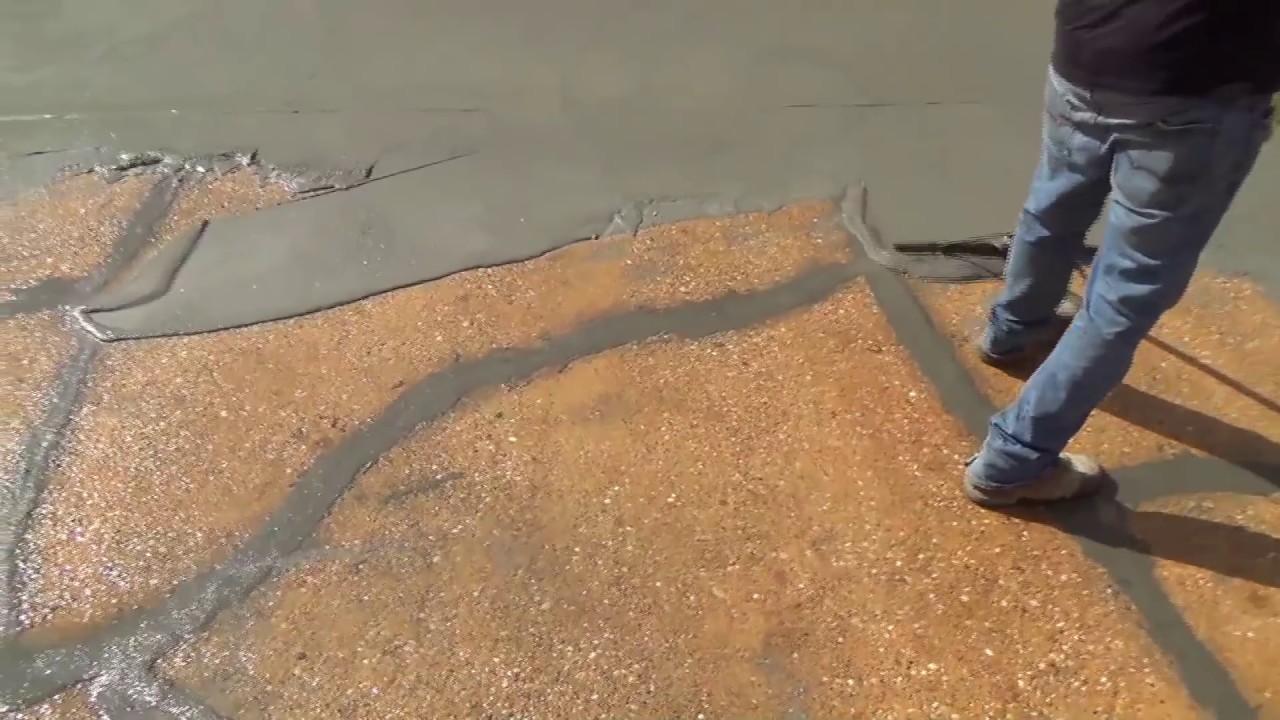
Patching Concrete Cracks
Clearly not all repairs require resurfacing the entire driveway. Driveway cracks come in a host of sizes and shapes—from hairline cracks to more significant fissures. Regardless of the size of the crack, there a few simple steps that should be taken before fixing the crack.
Clean It - The crack should be cleaned thoroughly to ensure proper bonding between the old surface and the repair material. Cleaning entails removing loose pieces of the old concrete with a chisel or equivalent tool and then removing the remaining debris with a wire brush and sweeping it away.
Fill It - The crack can then be repaired and filled with something as simple as concrete caulking for hairline cracks or concrete sealer (pourable concrete mixture) designed to fill larger cracks. You should also use a trowel to compress the material firmly into the crack.
For an aggregate driveway, you will want to pour sand over the concrete patch and roll over it with a somewhat heavy object.
Let It Cure - Once the patch is in place, it has to be allowed to dry and cure before you park a car on it. Curing is not the same as drying. Pourable concrete is easier to work with than the polymer coatings, not only because you are working on a much smaller area than you would be if resurfacing an entire driveway, but because they typically dry more slowly, allowing you time to work, plus many patching products are designed to cure quickly, to reduce the wait after you're done. Obviously, referring to the manufacturer’s instructions will alleviate any difficulties.
How To Repair Cracks In Ceiling
If you've used sand on the crack of an aggregate driveway, sweep or wash away the excess after the curing process has finished.
Seal It - Concrete is porous and water is one of the major culprits that can do damage to your driveway. To help minimize water damage, it is always a good idea to regularly apply a high-quality water sealer.
How To Repair Large Cracks In Cement Driveway
Moral of the Story
Repairing cracks in a concrete driveway is a simple project for most DIYers. Whether or not your driveway needs a complete overhaul or just the repair of small weathering cracks, there are products available that make the job easy.